

Sound familiar? Your mind is racing, your shoulders are up by your ears, your heart is beating faster than usual, and all you really want is for things to finally calm down. For many of us, stress has become a constant companion. That makes it all the more valuable to know a method you can use anytime, anywhere: no tools needed, just your own fingertips.
That’s exactly what EFT tapping is. In this article, you’ll learn what’s behind the method, how it may work and how to try it. At the end, you’ll find a complete tapping script that guides you from tension back to your center in just a few minutes.
What is EFT tapping?
EFT stands for “Emotional Freedom Techniques”. The method was developed in the 1990s by the American Gary Craig, who simplified an older tapping technique, the “Thought Field Therapy” of psychologist Roger Callahan.
The basic idea connects two worlds. From Traditional Chinese Medicine comes the knowledge of meridians and acupressure points. From modern psychology comes the idea of turning toward a difficult feeling consciously instead of pushing it away.
In practice, this means: you gently tap specific points on your head, upper body and hand with two or three fingertips. At the same time, you say out loud what’s bothering you right now, and combine it with a sentence of self-acceptance. So it isn’t about thinking positively, but about looking honestly and accepting yourself lovingly while you do.
How does EFT work?
Why tapping feels so good for so many people hasn’t been fully explained yet. But there are several explanations that complement each other well:
- Calming the nervous system: The gentle, rhythmic tapping works much like a soothing touch. Your body gets the signal that there’s no danger and can switch from alarm mode into relaxation mode.
- Connecting feelings and body: While you name what’s weighing on you, you’re sending your body a signal of safety at the same time. That way, the emotional charge of a memory or situation can gradually decrease.
- Self-acceptance instead of struggle: The sentence “I deeply and completely accept myself” takes the pressure off. You don’t have to get rid of the feeling to be okay, and that alone is often relaxing.
- Mindfulness: While tapping, you deliberately turn your attention inward. That alone interrupts the mental merry-go-round.
Research has looked at EFT as well. Some studies suggest that tapping may reduce feelings of stress and anxiety and may even lower the stress hormone cortisol.
However, the quality of the studies varies, and critics suspect that part of the effect comes from mindfulness and attention rather than from the meridians. What counts for you in everyday life is this: try it and feel for yourself what it does for you.
The tapping points at a glance
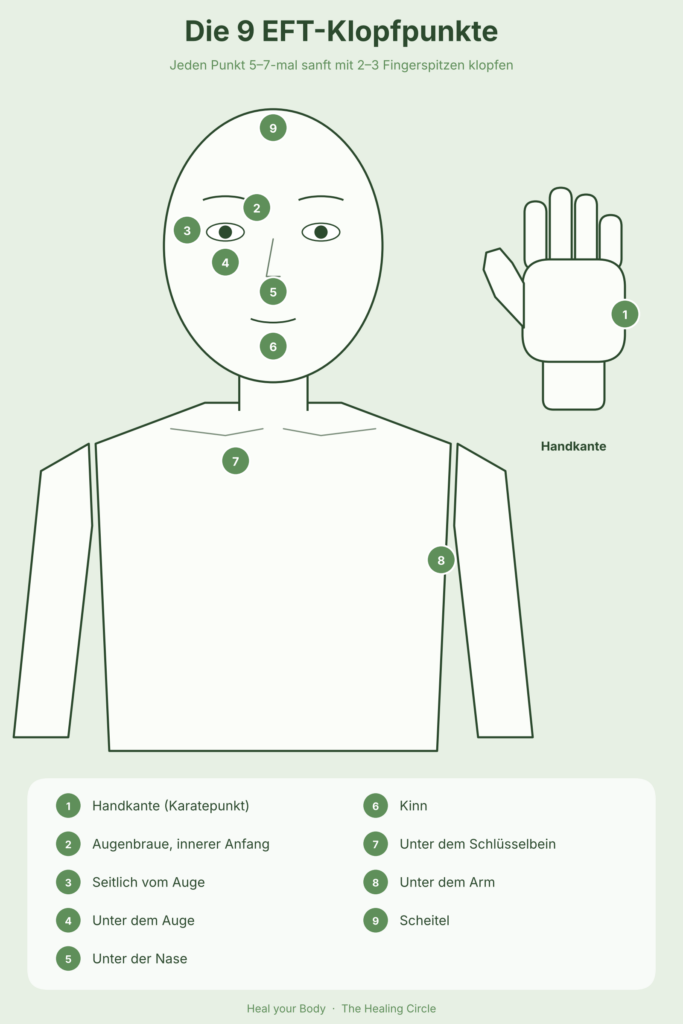
For one tapping round, you need nine points. It doesn’t matter whether you use the left or right side of your body; for the points on your face, you can also tap with both hands at the same time.
| No. | Tapping point | Where exactly? |
|---|---|---|
| 1 | Side of the hand (karate chop point) | The fleshy outer edge of the hand, between the wrist and the little finger |
| 2 | Eyebrow | The inner start of the eyebrow, just above the bridge of the nose |
| 3 | Side of the eye | On the bone at the outer corner of the eye |
| 4 | Under the eye | On the bone under the eye, roughly below the pupil |
| 5 | Under the nose | Between the nose and the upper lip |
| 6 | Chin | In the crease between the lower lip and the tip of the chin |
| 7 | Collarbone | About 1 inch (2–3 cm) below the collarbone, next to the breastbone |
| 8 | Under the arm | On the side of the body, about a hand’s width below the armpit |
| 9 | Top of the head | On top of the head, in the middle |
Tap each point about 5 to 7 times with two or three fingertips. The pressure should feel pleasant: firm enough to feel it, but never painful.
How a tapping round works
An EFT session always follows the same simple sequence. After practicing once or twice, you won’t need instructions anymore.
- Name the issue: Check in with yourself. What’s bothering you right now? The more specific, the better, for example “this pressure in my chest about tomorrow’s presentation”.
- Rate the intensity: How strong is the feeling on a scale from 0 (not at all) to 10 (unbearable)? Remember the number.
- Create your setup statement: It follows the pattern “Even though I [problem], I deeply and completely accept myself.” If that feels too big, just say: “… I’m okay just as I am.”
- Tap the side of your hand: Tap the karate chop point and say your setup statement three times, out loud or silently.
- Tap the round: Tap points 2 to 9 one after the other. At each point, say a short reminder phrase, such as “this pressure” or “this tension”.
- Breathe and rate again: Take a deep breath in and out. How strong is the feeling now? If it’s still above 2, tap another round.
Your tapping script: finding calm when you’re stressed
Allow about five to ten minutes for this script. Find a quiet place, sit comfortably and close your eyes if you like. Take two deep breaths and rate your stress on the scale from 0 to 10.
Setup (side of the hand, say each sentence once)
- “Even though I’m so stressed right now and everything is too much, I deeply and completely accept myself.”
- “Even though my mind won’t stop and my body is tense, I’m okay just as I am.”
- “Even though I feel like I’m always running behind, I allow myself to pause for a moment now.”
Round 1: Acknowledging the feeling
- Eyebrow: “All this stress.”
- Side of the eye: “Everything is too much right now.”
- Under the eye: “This tension in my body.”
- Under the nose: “I can feel the pressure.”
- Chin: “So many thoughts at once.”
- Collarbone: “I feel like I’m not allowed to take a break.”
- Under the arm: “This stress is deep in my bones.”
- Top of the head: “All of this stress.”
Take a deep breath in and out.
Round 2: Allowing myself to let go
- Eyebrow: “Maybe I don’t have to solve everything at once.”
- Side of the eye: “I’m allowed to take a breath now.”
- Under the eye: “My body can relax just a little bit.”
- Under the nose: “I let my shoulders drop.”
- Chin: “One step at a time.”
- Collarbone: “I’m safe, right here, right now.”
- Under the arm: “With every breath, I let a bit of the pressure go.”
- Top of the head: “I allow myself to become calmer.”
Take a deep breath in and out.
Round 3: Inviting calm
- Eyebrow: “I choose to be calm now.”
- Side of the eye: “I trust that I can handle this.”
- Under the eye: “I feel the ground beneath my feet.”
- Under the nose: “My breath becomes calm and deep.”
- Chin: “I am enough, even if not everything is done.”
- Collarbone: “Peace is spreading through me.”
- Under the arm: “I am calm and at ease.”
- Top of the head: “I’ve arrived back with myself.”
Take one last deep breath in and let it flow out slowly. Notice: where is your stress on the scale now? If it’s still high, repeat Rounds 1 and 2. Often just two or three rounds are enough to feel a clear difference.
Tips for getting started
- Use your own words: The script is only a suggestion. Speak the way you think and feel; that often makes it even more effective.
- Perfection doesn’t matter: Not hitting a point exactly? No problem. The points are bigger than you think, and your body understands the intention.
- Start small: Begin with everyday stress, such as before an appointment or after a hectic day, rather than deep, old wounds.
- Practice regularly: A few minutes a day, for example in the morning or before bed, help you internalize the method.
- Tap discreetly: When you’re out and about, it’s often enough to tap just the side of your hand or your fingertips and say the sentences in your head.
Important note: EFT is a self-help method and does not replace medical or psychotherapeutic treatment. If stress, anxiety or difficult experiences affect you persistently, or if strong feelings come up while tapping, please get professional support, for example from your doctor or a therapist.
Conclusion: calm is in your hands
EFT tapping is simple, free and available anytime. All you need is a few minutes, your fingertips and the willingness to be honest with yourself. Especially on stressful days, tapping can be a small anchor that brings you back to yourself.
Try the script the next time you feel stressed, and notice how your body feels afterwards. Your body often holds more wisdom for healing than we give it credit for.
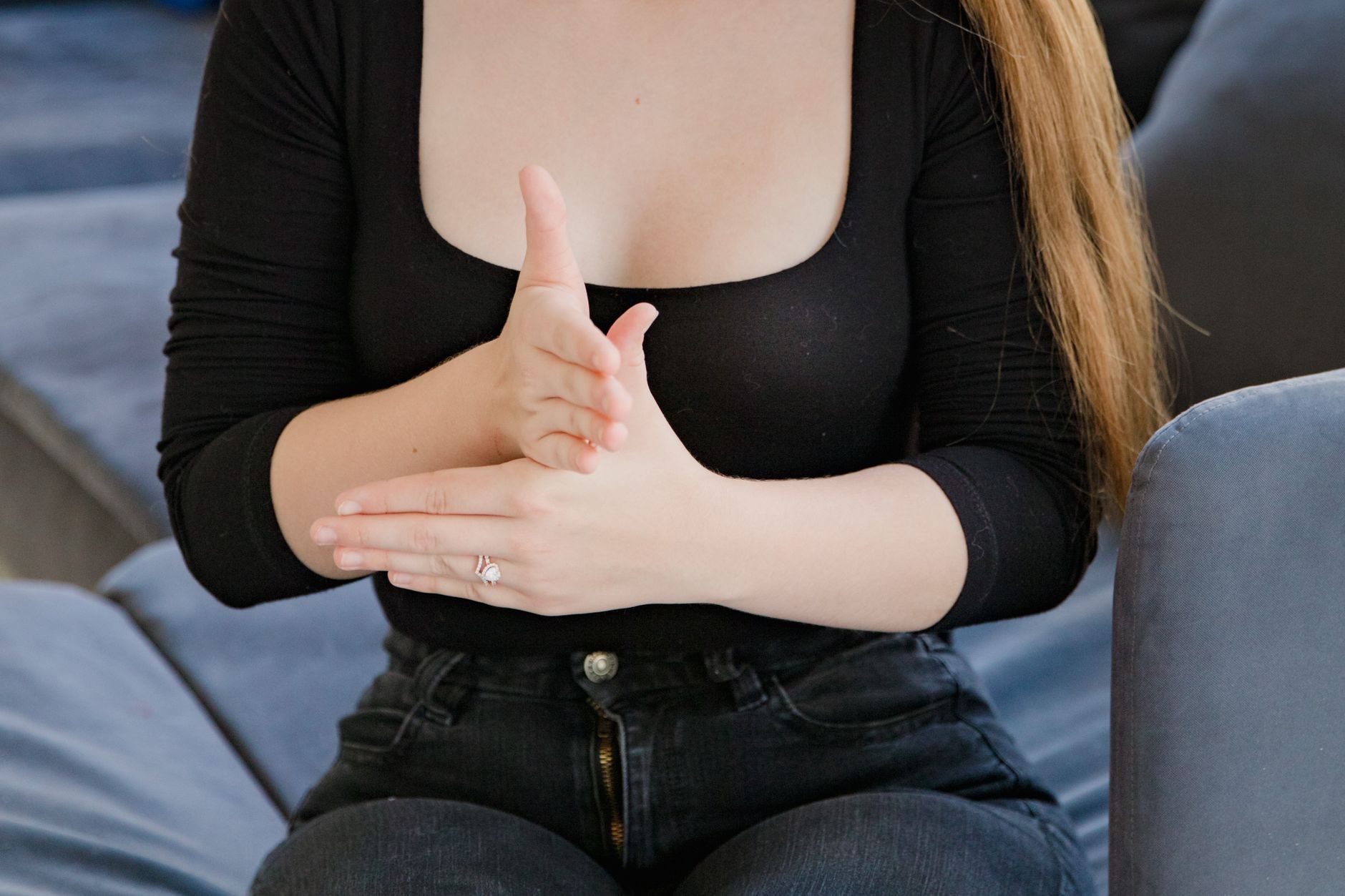
Your next step: Heal your Body – The Workbook
If you notice that tapping does you good, but you’d like to find calm not only in acute moments of stress, Heal your Body – The Workbook guides you through a 7-day nervous system reset. For one week, you get a small, doable session every day: insights into what happens in your body during stress, regulation exercises and space to write directly in the workbook.
The workbook is for anyone who doesn’t need more to-dos, but gentle routines that fit into a busy life. Instead of just reading, you capture your thoughts, progress and small wins in black and white, and after seven days you can see how much has already changed.
Get Heal your Body – The Workbook here
Part of the Circle
Stress doesn’t only show up in the body, but also in how we treat other people. Some of us don’t fight or flee, but suddenly become especially nice, accommodating and eager to keep the peace. Why that is a real stress response of your nervous system is something you can read about on Heal your Mind: The Fourth Stress Response Nobody Talks About: Fawning.
Leave a Reply